International Journal of Molecular Medicine is an international journal devoted to molecular mechanisms of human disease.
International Journal of Oncology is an international journal devoted to oncology research and cancer treatment.
Covers molecular medicine topics such as pharmacology, pathology, genetics, neuroscience, infectious diseases, molecular cardiology, and molecular surgery.
Oncology Reports is an international journal devoted to fundamental and applied research in Oncology.
Experimental and Therapeutic Medicine is an international journal devoted to laboratory and clinical medicine.
Oncology Letters is an international journal devoted to Experimental and Clinical Oncology.
Explores a wide range of biological and medical fields, including pharmacology, genetics, microbiology, neuroscience, and molecular cardiology.
International journal addressing all aspects of oncology research, from tumorigenesis and oncogenes to chemotherapy and metastasis.
Multidisciplinary open-access journal spanning biochemistry, genetics, neuroscience, environmental health, and synthetic biology.
Open-access journal combining biochemistry, pharmacology, immunology, and genetics to advance health through functional nutrition.
Publishes open-access research on using epigenetics to advance understanding and treatment of human disease.
An International Open Access Journal Devoted to General Medicine.
Oncol Rep 34: [Related article:] 77-86, 2015; DOI: 10.3892/or.2015.3943
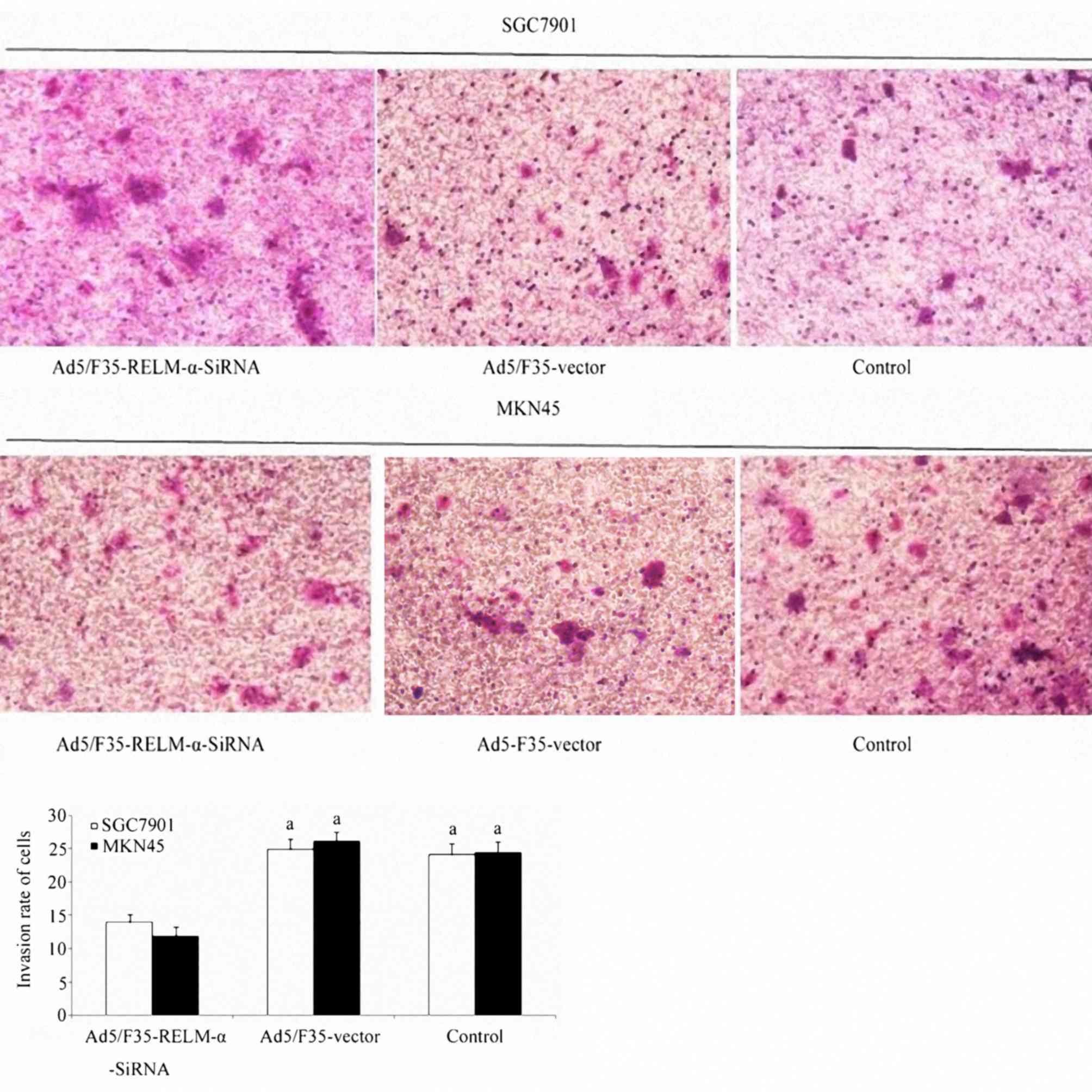
Following the publication of the above article, the authors have drawn to our attention that, in Fig. 6 on p. 83, the ‘Ad5/F-35 vector’ and ‘Control’ experiment data panels for the MKN45 cell line were inadvertently derived from the same original source. The Ad5/F35-vector and Control groups were both negative controls; Ad5/F35-vector was the empty vector condition, whereas ‘Control’ represented the ‘no vector’ experiment. A representative image belonging to the Control MKN45 experiment was inadvertently used to show the ‘Ad5-F35-vector’ experiment. An examination of the original data files confirmed that the data shown in the histogram for Fig. 6 were correct; therefore, this error in terms of figure placement did not influence the statistical analysis shown for the invasive ability of the cells.
A corrected version of Fig. 6, containing correct representative data for the ‘Ad5-F35-vector’ experiment, is shown opposite. This error did not affect the results or the conclusions reported in this study. The authors sincerely apologize for this mistake, and regret any inconvenience this mistake has caused.